
· by Sonny
What to do if your car breaks down in Southern California
A practical, step-by-step guide for staying safe and getting help when your vehicle stops on a SoCal road or freeway.
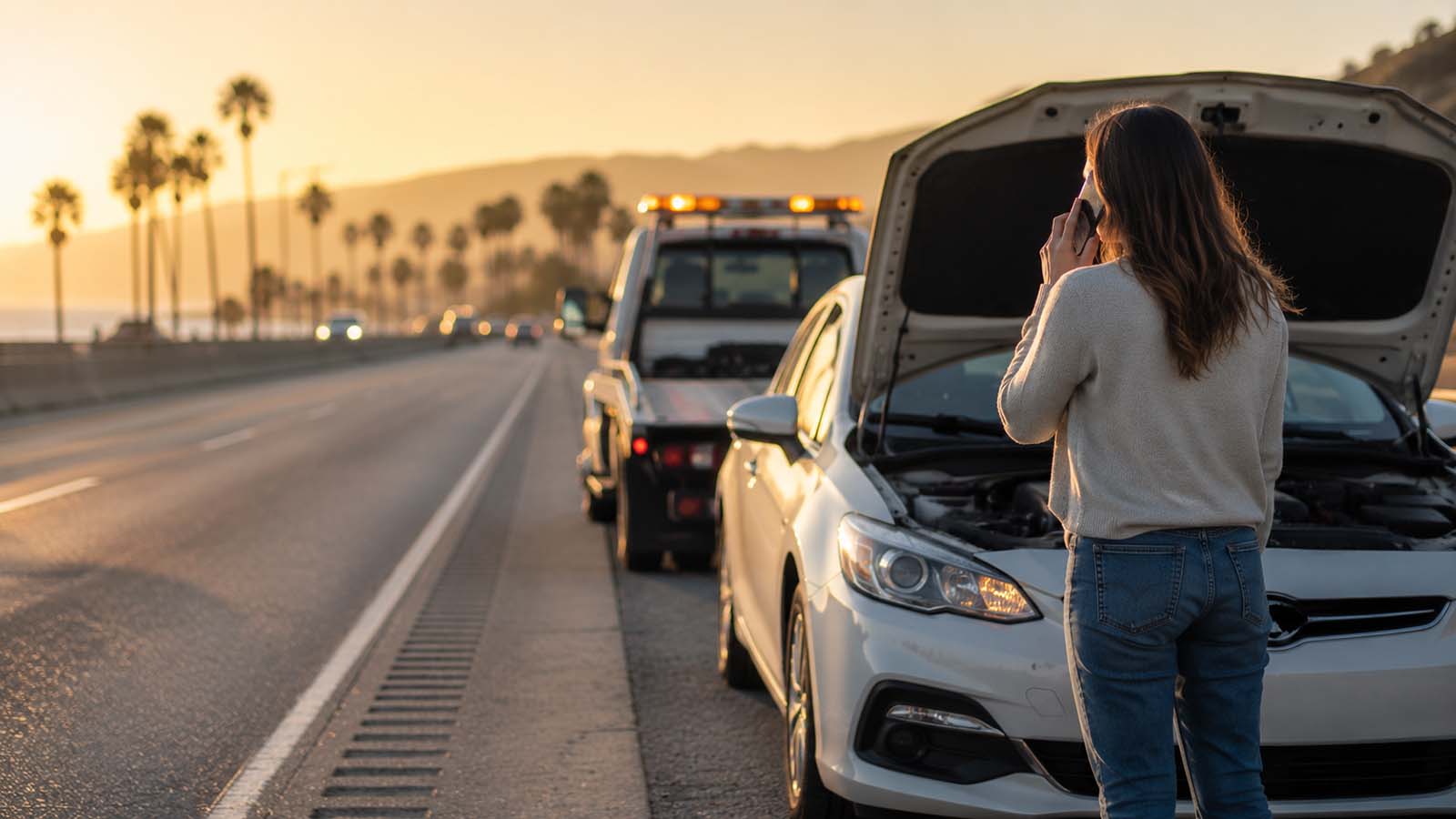
A breakdown is stressful. A breakdown on the 101 at 5 PM is really stressful. Here’s the playbook we share with friends and family — short, practical, and SoCal-specific.
1. Get off the road safely
The most dangerous moment of any breakdown is the one where your car is slowing down in a live lane. As soon as you sense a problem:
- Hazards on. Immediately.
- Aim right. Drift toward the right shoulder if it’s safe. If you’re on the 405 in the fast lane, don’t make sudden moves across four lanes — ease right as gaps appear.
- Exit if you can. A surface street is almost always safer than a freeway shoulder. If an off-ramp is within coasting distance, take it.
2. Stay in the car (usually)
On a freeway shoulder in California, the safest place is usually inside your vehicle with the seatbelt on. Cars get clipped by inattentive drivers regularly.
Exit only if:
- You smell smoke or fuel
- There’s a hill or curve that hides you from oncoming traffic
- You’re somewhere a tow truck obviously can’t reach you (a tunnel, etc.)
If you do exit, go to the passenger side away from traffic, climb up a slope, and stay there.
3. Call for help
Have ready: your location (mile marker, exit number, cross street, or GPS coordinates from your phone), your vehicle make/model/color, and a quick description of what happened.
If you call us, we’ll quote a flat price before we dispatch and give you a real ETA. If it’s a serious mechanical issue, we’ll coordinate the right tow truck instead of sending the wrong kind of help.
4. Don’t accept random “help”
Unsolicited tow trucks that pull over to “help” — especially on the 5, 405, and 605 — are a known scam vector. They’ll often hook your car before you can argue, then charge several times the going rate. Call a roadside service you chose. If a tow truck shows up that you didn’t call, politely decline.
5. While you wait
- Keep your seatbelt on
- Don’t sit on the trunk or fender (rear-end collisions on shoulders are unfortunately common)
- If it’s hot out, run the AC sparingly — overheating can compound an already-bad day
- Note the time you called dispatch; this is useful if anything goes sideways with the service
When to call us vs. when to call 911
Call 911 if:
- Anyone is injured
- The vehicle is on fire or smoking heavily
- You’ve been hit or are in an active collision
- You’re in a lane and can’t get to the shoulder
Call us for everything else — dead batteries, flat tires, lockouts, empty tanks, or just a car that suddenly won’t go.
Drive safe out there.